Israel is the Nation of the Antichrist = Dajjal
World War III and the False Peace: Commodianus - quoting oral sayings that are the root of the hadiths later in Islamic tradition for the Mahdi.
Parallel secret services | LAUNCHING THE U.S. TERROR WAR (2/3)
World War III and the False Peace: Commodianus - quoting oral sayings that are the root of the hadiths later in Islamic tradition for the Mahdi.
Parallel secret services | LAUNCHING THE U.S. TERROR WAR (2/3)
Parallel secret services
by Peter Dale Scott
Continuing his analysis, Peter Dale Scott shows that liaison arrangements among the intelligence agencies of allied countries gave rise to parallel services and shadow operations. This former Canadian diplomat thereby reveals the method that allowed the September 11 plotters to employ means appertaining to the U.S. state apparatus without the knowledge of other insiders.

This article follows "The CIA, 9/11, Afghanistan, and Central Asia"
The Liaison Agreements with Other Intelligence Agencies
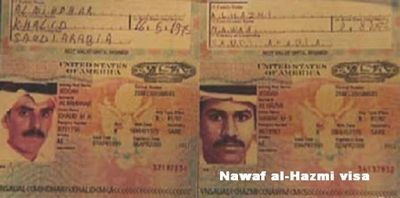
Initially, I believe, al-Mihdhar and al-Hazmi may have been protected because they had been sent to America by the Saudi GID intelligence service, which would explain why after their arrival they were apparently bankrolled indirectly by the Saudi embassy in Washington. The facts are well summarized by Paul Church in Asia Times Online (February 11, 2012):
Between 1998 and 2002, up to US$73,000 in cashier cheques was funneled by [Saudi Ambassador Prince] Bandar’s wife Haifa - who once described the elder Bushes as like "my mother and father" - to two Californian families known to have bankrolled al-Midhar and al-Hazmi. … Princess Haifa sent regular monthly payments of between $2,000 and $3,500 to Majeda Dweikat, wife of Osama Basnan, believed by various investigators to be a spy for the Saudi government. Many of the cheques were signed over to Manal Bajadr, wife of Omar al-Bayoumi, himself suspected of covertly working for the kingdom. The Basnans, the al-Bayoumis and the two 9/11 hijackers once shared the same apartment block in San Diego. It was al-Bayoumi who greeted the killers when they first arrived in America, and provided them, among other assistance, with an apartment and social security cards. He even helped the men enroll at flight schools in Florida.” [1]
If the two Saudis were in fact sent by the GID, they would almost certainly have been admitted to the U.S. under the terms of the liaison agreement between the GID and the CIA. [2] Prince Turki al-Faisal, former head of the GID, has said that he shared his al Qaeda information with the CIA, and that in 1997 the Saudis “established a joint intelligence committee with the United States to share information on terrorism in general and on…al Qaeda in particular.” [3] The 9/11 Commission Report adds that after a post-millennium review, the Counterterrorism Center (which included Alec Station, the Bin Laden Unit) intended to proceed with its plan of half a year earlier, “building up the capabilities of foreign security services that provided intelligence via liaison.” [4]
This was a Blee specialty. Steve Coll reports that Richard Blee and his superior Cofer Black, excited about the opportunities presented by liaison arrangements for expanding the scope of CIA reach in critical regions, had flown together into Tashkent in 1999, and negotiated a new liaison agreement with Uzbekistan. [5] According to Coll and the Washington Post, this arrangement soon led, via Tashkent, to a CIA liaison inside Afghanistan with the Northern Alliance. [6] Thomas Ricks and Susan Glasser reported in the Washington Post that, beginning after the embassy bombings in Dar es Salaam and Nairobi in 1998, “The United States and Uzbekistan have quietly conducted joint covert operations aimed at countering Afghanistan’s ruling Taliban regime and its terrorist allies …, according to officials from both nations.” [7]
This involvement in Uzbekistan was part of a wider regional pattern. Beginning in 1997, the U.S. had begun a series of annual military maneuvers with Kazakh, Kyrgyz, and Uzbek forces, as exercises for possible deployment of combat U.S. forces in the region.
CENTRAZBAT ’97, as it was known, was clearly a test of America’s ability to project power into the Caspian basin in the event of a crisis. “There is no nation on the face of the earth that we cannot get to,” said General Jack Sheehan…the highest-ranking officer to attend the exercise. And, lest anyone doubted the nature of our interests in the region, a deputy assistant secretary of defense accompanying Sheehan, Catherine Kelleher, cited “the presence of enormous energy resources” as a justification for American military involvement. The 1997 operation was the first in an annual series CENTRAZBAT exercises designed to test the speed with which Washington could deploy U.S.-based forces directly to the region and commence combat operations. [8]
In other words, the Pentagon had been active in Uzbekistan for four years before the public Rumsfeld-Karimov agreement of October 2001.
[Insert K-2 picture here. Move Panjshir photo to p. 28, after Massoud reference at footnote 94]
Speaking as a former junior diplomat, let me observe that a liaison arrangement would probably have required special access clearances for those privy to the arrangement and sharing the liaison information. [9] This would explain the exclusion of the FBI agents who were not cleared for this information, as well as the behavior of other non-cleared CIA agents who proceeded to collect and disseminate information about the two alleged hijackers. Alec Station needed both to protect the double identity of the two Saudis, and to make sure that they were not embarrassingly detained by the FBI.
Almost certainly the CIA had relevant liaison arrangements, not just with the Saudi GID and Uzbekistan, but also with the Inter-Services Intelligence (ISI) of Pakistan, as well as the intelligence services of Egypt, and perhaps Yemen and Morocco. In particular there is reason to think that Ali Mohamed, a double agent who was protected by the FBI from being detained in Canada, thus allowing him to help organize the al Qaeda embassy bombings of 1998, was permitted under such arrangements to enter the US as an agent of foreign intelligence, probably Egyptian. [10] Ali Mohamed figures both in the content and as source of the President’s Daily Brief (PDB) of August 6, 2001, in which the CIA warned the president, “Bin Ladin Determined to Strike in US.” [11] According to Mohamed’s FBI handler, Jack Cloonan, “all that information came from Ali,” while the PDB itself attributes its key finding to what “an Egyptian Islamic Jihad (EIJ) operative told an [---] service.” [12] (Ali Mohamed was definitely EIJ, and this service was probably Egyptian.)
But when Mohamed, like al-Mihdhar and al-Hazmi, was inappropriately admitted to the US, it was reportedly not by the CIA, but possibly by “some other Federal agency.” [13]
This was very possibly a Pentagon agency, because from 1987 to 1989, Ali Mohamed “was assigned to the U.S. [Army] Special Operations Command [SOCOM] in Fort Bragg, the home of the Green Berets and the Delta Force, the elite counterterrorism squad.” [14] SOCOM, which includes JSOC (the Joint Special Operations Command), has its own intelligence division; [15] and SOCOM is the command that first mounted the Able Danger program in 1999 to track al Qaeda operatives, and then, inexplicably, both shut it down before 9/11 and destroyed its database. [16] In addition SOCOM was working in Uzbekistan with CIA operatives as a result of the liaison agreement negotiated by Cofer Black and Richard Blee of the CTC.
For this and other reasons, I suggest reconceptualizing what Fenton calls the anomalous “Alec Station group” as an inter-agency liaison team (or teams) with special access clearances, including Alec Station personnel, collaborating personnel in the FBI, and possibly SOCOM. (One of these collaborators was FBI agent Dina Corsi, who according to Fenton withheld vital information from fellow agent Steve Bongardt even after the NSA had cleared it for him.) [17]
Background: the Safari Club and William Casey
These arrangements can be traced in one form or another, at least back to the 1970s. Then senior CIA officers and ex-officers (notably Richard Helms), who were dissatisfied with the CIA cutbacks instituted under Jimmy Carter’s CIA director, Stansfield Turner, organized an alternative network, the so-called Safari Club. Subordinated to intelligence chiefs from France, Egypt, Saudi Arabia, Morocco and (under the Shah) Iran, the Safari Club provided a home to CIA officers like Theodore Shackley and Thomas Clines, who had been marginalized or fired by CIA Director Turner. As Prince Turki later explained, the purpose of the Safari Club was not just to exchange information, but to conduct covert operations that the CIA could no longer carry out directly in the wake of the Watergate scandal and subsequent reforms. [18]
In the 1980s, CIA Director William Casey made key decisions in the conduct of the Afghan covert war, not through his own CIA bureaucracy but with the Saudi intelligence chiefs, first Kamal Adham and then Prince Turki. Among these decisions was the creation of a foreign legion to assist the Afghan mujahideen in their war against the Soviets – in other words, the creation of that support network which, since the end of that war, we have known as al Qaeda. [19] Casey worked out the details with the two Saudi intelligence chiefs, and also with the head of the Bank of Credit and Commerce International (BCCI), the Saudi-Pakistani bank in which Adham and Turki were both shareholders.
In so doing, Casey was in effect running a second or back-channel CIA, building up the future al Qaeda in Pakistan with the Saudis, even though the official CIA hierarchy underneath him in Langley rightly “thought this unwise.” [20] In American War Machine, I situated the Safari Club and BCCI in a succession of ”second CIA” or “alternative CIA” arrangements dating back to the creation of the Office of Policy Coordination (OPC) in 1948. Thus it is relevant that CIA Director George Tenet, following Casey’s precedent, met with Saudi Ambassador Bandar around once a month, and would not tell CIA officers handling Saudi issues what he had discussed. [21]
Fenton himself invokes the example of the Safari Club in proposing the possible explanation that Blee and Wilshire used a “parallel network” to track al-Mihdhar and al-Hazmi inside the United States. In his words, “Withholding the information about Almihdhar and Alhazmi only makes sense if the CIA was monitoring the two men in the US itself, either officially or off the books.” [22] But a third option would be that the GID was monitoring their movements, a situation quite compatible with Saudi Prince Bandar’s claim that Saudi security had been “actively following the movements of most of the terrorists with precision.” [23]
Joseph and Susan Trento heard from a former CIA officer, once based in Saudi Arabia, that “Both Hazmi and Mihdhar were Saudi agents.” [24] If so, they were clearly double agents, acting (or posing) as terrorists at the same time they were acting (or posing) as informants. In espionage, double agents are prized and often valuable; but to rely on them (as the example of Ali Mohamed illustrates) can also be dangerous.
This was particularly the case for the CIA with respect to Saudi Arabia, whose GID supported al Qaeda energetically in countries like Bosnia, in exchange for a pledge (negotiated by Saudi Interior Minister Naif bin Abdul Aziz with Osama bin Laden) that al Qaeda “would not interfere with the politics of Saudi Arabia or any Arab country.” [25] Pakistan’s ISI was even more actively engaged with al Qaeda, and some elements of ISI were probably closer to the ideological goals of al Qaeda, than to Pakistan’s nominally secular government.
But in all cases the handling of illegal informants is not just dangerous and unpredictable, but corrupting. To act their parts, the informants must break the law; and their handlers, knowing this, must protect them by failing to report them, and then, all too often, intercede to prevent their arrest by others. In this way, handlers, over and over again, become complicit in the crimes of their informants. [26]
Even in the best of circumstances, decisions have to be made whether to allow an informant’s crime to go forward, or to thwart it and risk terminating the usefulness of the informant. In such moments, agencies are all too likely to make the choice that is not in the public interest.
A very relevant example is the first World Trade Center bombing of 1993 – relevant because Khalid Sheikh Mohammed, the alleged mastermind of 9/11, was one of the 1993 plotters as well. The FBI had an informant, Emad Salem, among the 1993 plotters; and Salem later claimed, with supporting evidence from tapes of his FBI debriefings, that the FBI deliberately chose not to shut down the plot. Here is Ralph Blumenthal’s careful account in the New York Times of this precursor to the mystery of 9/11:
Law-enforcement officials [i.e. the FBI] were told that terrorists were building a bomb that was eventually used to blow up the World Trade Center, and they planned to thwart the plotters by secretly substituting harmless powder for the explosives, an informer said after the blast.
The informer was to have helped the plotters build the bomb and supply the fake powder, but the plan was called off by an F.B.I. supervisor who had other ideas about how the informer, Emad A. Salem, should be used, the informer said.
The account, which is given in the transcript of hundreds of hours of tape recordings Mr. Salem secretly made of his talks with law-enforcement agents, portrays the authorities as in a far better position than previously known to foil the Feb. 26 bombing of New York City’s tallest towers. The explosion left six people dead, more than 1,000 injured and damages in excess of half a billion dollars. Four men are now on trial in Manhattan Federal Court in that attack. [27]
What makes the 1993 plot even more relevant is that Salem, according to many sources, was an agent of the Egyptian intelligence service, sent to America to spy on the actions of the Egyptian “Blind Sheikh” Omar Abdel Rahman. [28] This raises the possibility that the F.B.I. supervisor who had “other ideas” about how to use Emad Salem, was a member of a liaison team, with special knowledge he could not share with other FBI agents. It may have been, for example, that the Egyptian intelligence service declined to let Salem’s cover be blown. This suggestion is both speculative and problematic, but it has the advantage of offering a relatively coherent explanation for otherwise baffling behavior.
This explanation does not at all rule out the possibility that some officials had more sinister motives for allowing the bombing to take place and covering it up afterwards. Sheikh Omar Abdel Rahman was at this very time a key figure in a sensitive Saudi program, signed on to by U.S. officials as well, to supply mujahideen warriors in Bosnia against Serbia (including some, like Ayman al-Zawahiri, who were later accused of the 9/11 plot). [29] It is clear from both investigative and prosecutorial behavior that a number of different US agencies did not want to disturb Rahman’s activities. Even after Rahman himself was finally indicted in the 1995 conspiracy case to blow up New York landmarks, the US Government continued to protect Ali Mohamed, a key figure in the conspiracy.
Worse, the performance of the FBI in allowing the bombing to proceed was only one of a series of interrelated bungled performances and missed opportunities, climaxing with 9/11. The first was in connection with the murder in New York of the Jewish extremist Meir Kahane. The FBI and NY police actually detained two of the murderers in that case and then released them, allowing them to take part in the WTC bombing of 1993. A key trainer of the two men was Ali Mohamed while still in U.S. Special Forces, whose name was systematically protected from disclosure by the prosecuting attorney, Patrick Fitzgerald. Then in 1994, when Ali Mohamed was detained in Vancouver by the Canadian RCMP, the FBI intervened to arrange for his release. This freed Mohamed to proceed to Kenya, where he became the lead organizer of the 1998 US Embassy bombing in Nairobi. [30]
Ali Mohamed was finally detained by the Americans in 1998, but still not imprisoned. He was apparently still a free man when he readily confessed to his FBI handler, Jack Cloonan, that he not only knew at least three of the 9/11 alleged hijackers, but had helped instruct them in how to hijack airplanes. [31] According to Ali Soufan, in a book released in September 2011, Ali Mohamed was still awaiting sentencing in 2011, twelve years after his guilty plea in May 1999. [32]
We have to conclude that there is something profoundly dysfunctional going on here, and has been going on since before 9/11, indeed under both political parties. The conditions of secrecy created by special clearances have not just masked this dysfunctionality; they have, I would argue, helped create it. The history of espionage demonstrates that secret power, when operating in the sphere of illegal activities, becomes, time after time, antithetical to public democratic power. [33] The more restricted the group of special planners with special clearances, the less likely are their decisions to conform with the dictates of international and domestic law, still less with common morality and common sense.
Add to these conditions of unwholesome secrecy the fundamentally unhealthy, indeed corrupt, relationship of U.S. intelligence agencies to those of Saudi Arabia and Pakistan. This has been profoundly anti-democratic both at home and in Asia. The US dependency on Saudi oil has in effect subsidized a wealth-generated spread of Islamic fundamentalism throughout the world, while what the 99.9 percent of ordinary Americans pay for oil and gas generates huge sums, which Saudis then recycle into the financial institutions of the one tenth of one percent at the pinnacle of Wall Street.
In like manner, America’s fraught relationship with the ISI of Pakistan has resulted in a dramatic increase in international heroin trafficking by the two agencies’ Afghan clients. [34] In short the bureaucratic dysfunction we are talking about in 9/11 is a symptom of a larger dysfunction in America’s relationship with Saudi Arabia, with Pakistan, and through them with the rest of the world.
Liaison Agreements and the Protection of Al-Mihdhar and Al-Hazmi
Even without the suggestive precedent of the 1993 WTC bombing, it is legitimate to posit that liaison agreements may have inhibited the roundup of Khalid al-Mihdhar and Nawaf al-Hazmi. Let us consider first Fenton’s finding of fact: “It is clear that this information [about the two men] was not withheld through a series of bizarre accidents, but intentionally.” [35] This finding I consider rock hard. But we cannot be so confident about his explanation: that “the purpose of withholding the information had become to allow the attacks to go forward.” [36]
I believe that in fact there are a number of possibilities about the intention, ranging from the relatively innocent (the inhibitions deriving from a liaison agreement) to the nefarious. Before considering these, let us deconstruct the notion of “letting the attacks go forward.” Clearly, if the alleged hijackers were not detained at the airport gates, people would probably have been killed – but how many? Recall that in the Operation Northwoods documents, which envisaged planning “false flag” attacks to justify a U.S. military intervention in Cuba, the Joint Chiefs wrote “We could develop a Communist Cuban terror campaign” in which “We could sink a boatload of Cubans.” [37] Would the loss of four planeloads of passengers have been a qualitatively different tragedy?
Of course 9/11 became a much greater tragedy when three of the planes hit the two Towers and the Pentagon. But it is possible that the liaison minders of the two Saudis did not imagine that their targets were capable of such a feat. Recall that their flying lessons, even in a Cessna, were such a fiasco that the lessons were quickly terminated. Their instructor told them “that flying was simply not for them.” [38]
Let me suggest that there are three separable ingredients to the 9/11 attacks: the hijackings, the strikes on the buildings, and the astonishing collapse of the three WTC buildings. It is at least possible that the Alec Station liaison team, as a group, contemplated only the first stage, without ever imagining the two stages that ensued.
A minimal, least malign initial explanation for the withholding of information about two of the alleged hijackers would be the hypothesis I proposed in the case of Emad Salem – the restricted access created by the special clearance for a liaison agreement. But just as in 1993, the secret power created behind the wall of restrictive clearances may have been exploited for ulterior purposes. The dangerous situation thus created – of potential would-be-hijackers being protected from detention at a time of expected attack – may have inspired some to exploit the resulting conditions of secrecy as an opportunity to plan an incident to justify war. One important analogy with the 1964 false Second Tonkin Gulf Incident that was used to justify attacking North Vietnam is the same presence of a powerful faction – in 2001 the PNAC clique inside government – that was bent on unilateral military action. [39]
One clue to this more sinister intention is that the pattern of withholdings detailed by Fenton is not restricted exclusively to the two Saudis and their CIA station handlers. There are a few concatenating withholdings by other agencies – above all the Able Danger info that was destroyed at SOCOM and the withholding – apparently by NSA — of an important relevant intercept, apparently about the alleged hijackers and Moussaoui. [40]
If the NSA was withholding information from relevant officials, it would recall the role of the NSA at the time of the second Tonkin Gulf Incident in August 1964. Then the NSA, at a crucial moment, forwarded 15 pieces of SIGINT (signals intelligence) which indicated – falsely – that there had been a North Vietnamese attack on two US destroyers. At the same time NSA withheld 107 pieces of SIGINT which indicated – correctly – that no North Vietnamese attack had occurred. [41] NSA’s behavior at that time was mirrored at the CIA: both agencies were aware of a powerful consensus inside the Johnson administration that had already agreed on provoking North Vietnam, in hopes of creating an opportunity for military response. [42]
We know from many accounts of the Bush administration that there was also a powerful pro-war consensus within it, centered on Cheney, Rumsfeld, and the so-called cabal of PNAC (the Project for the New American Century) that before Bush’s election had been lobbying vigorously for military action against Iraq. We know also that Rumsfeld’s immediate response to 9/11 was to propose an attack on Iraq, and that planning for such an attack was indeed instituted on September 17. [43] It is worth considering whether some of those protecting the alleged hijackers from detention did not share these warlike ambitions. [44]
[1] The 9/11 Commission Report discounted the importance of al-Bayoumi (217-18); but the Report of the Joint Congressional Inquiry into 9/11 (173-77), even though very heavily redacted at this point, supplied corroborating information, including a report that Basnan had once hosted a party for the “Blind Sheikh” Omar Abdurrahman, involved in the first World Trade Center bombing of 1993.
[2] At first I suspected, as have others, that the two men were Saudi double agents. Another possibility is that they were sent as designated targets, to be surveilled by the Saudis and the Americans separately or together. One of my few disagreements with Fenton is when he calls al-Mihdhar “one of [the hijackers’] most experienced operatives” (Fenton, Disconnecting the Dots, 205). My own impression is that he was either an inexperienced and incompetent spy, or else someone deliberately exposing himself to detection, in order to test American responses.
[5] Steve Coll, Ghost Wars: the secret history of the CIA, Afghanistan, and bin Laden, from the Soviet invasion to September 10, 2001 (New York: Penguin, 2004), 456-57.
[8] Michael Klare, Blood and Oil (New York: Metropolitan Books/ Henry Holt, 2004), 135-36; citing R. Jeffrey Smith, “U.S. Leads Peacekeeping Drill in Kazakhstan,” Washington Post, September 15, 1997. CF. Kenley Butler, “U.S. Military Cooperation with the Central Asian States,” September 17, 2001,.
[9] In 1957, I myself, as a junior Canadian diplomat, acquired a special access, higher-than-top-secret clearance to access intelligence from NATO, a relatively overt and straightforward liaison.
[11] Scott, Road to 9/11, 158; citing John Berger, “Unlocking 9/11: Paving the Road to 9/11”: ”Mohamed was one of the primary sources for the infamous Aug. 6, 2001, presidential daily brief (PDB) entitled ‘Bin Laden Determined to Strike in U.S.’” The PDB, often cited as an example of the CIA’s good performance, is in my opinion more probably another example of the Bin Laden Unit salting the record in preparation for post-9/11 scrutiny. The PDB, without naming Ali Mohamed, refers to him no less than three times as a threat, despite the fact that at the time he was under USG control awaiting sentence for his role in the 1998 embassy plots. The PDB, in other words, appears to have been a performance for the record, analogous to Wilshire’s performance in the same month of August at the FBI.
[14] Raleigh News and Observer, November 13, 2001; in Scott, Road to 9/11, 347. I have added the word “Army.” The HQ for USSOCOM itself is at Fort MacDill Air Force Vase in Florida.
[15] Dana Priest and William M. Arkin, “‘Top Secret America’: A look at the military’s Joint Special Operations Command,” Washington Post, September 2, 2011,.
[19] Ahmed Rashid, Taliban: Militant Islam, oil, and fundamentalism in Central Asia (New Haven CT: Yale UP, 2000), 129.
[21] James Risen, State of War: the secret history of the CIA and the Bush administration (New York: Free Press, 2006), 188-89.
[24] Joseph J. and Susan B. Trento, in Summers, Eleventh Day, 399. Since I presented this paper at a conference in Toronto on September 11, 2011, “Bob Kerrey of Nebraska, a Democrat who served on the … 9/11 Commission, [has] said in a sworn affidavit … that ‘significant questions remain unanswered’ about the role of Saudi institutions. ‘Evidence relating to the plausible involvement of possible Saudi government agents in the September 11th attacks has never been fully pursued,’ Mr. Kerrey said” (“Saudi Arabia May Be Tied to 9/11, 2 Ex-Senators Say,” New York Times, February 29, 2001, ).
[26] Such corruption is predictable and very widespread. In the notorious cases of Gregory Scarpa and Whitey Bulger, FBI agents in the New York and Boston offices were accused of giving their mob informants information that led to the murder of witnesses and other opponents. Agents in the New York office of the old Federal Bureau of Narcotics became so implicated in the trafficking of their informants that the FBN had to be shut down and reorganized.
[27] Ralph Blumenthal, “Tapes Depict Proposal to Thwart Bomb Used in Trade Center Blast,” New York Times, October 28, 1993, emphasis added. The next day, the Times published a modest correction: “Transcripts of tapes made secretly by an informant, Emad A. Salem, quote him as saying he warned the Government that a bomb was being built. But the transcripts do not make clear the extent to which the Federal authorities knew that the target was the World Trade Center.
[29] Peter Dale Scott, "Bosnia, Kosovo, and Now Libya: The Human Costs of Washington’s On-Going Collusion with Terrorists," Asia-Pacific Journal: Japan Focus, July 29, 2011, http://japanfocus.org/-Peter_Dale-S.... Evan Kohlmann has described how a Zagreb office in support of the Saudi-backed jihad in Bosnia received “all orders and funding directly from the main United States office of Al-Kifah on Atlantic Avenue controlled by Shaykh Omar Abdel Rahman” (Evan Kohlmann, Al-Qaida’s Jihad in Europe, 39-41; citing Steve Coll and Steve LeVine, “Global Network Provides Money, Haven,” Washington Post, August 3, 1993).
[30] Scott, Road to 9/11, 153, 347; citing “Canada freed top al-Qaeda operative,” Toronto Globe and Mail, November 22, 2001,
[33] The corruption appears to be inevitable in superpowers – states which have accumulated power in access of what is needed for their own defense. The pattern is less discernible in less powerful states like Canada.
[34] "America’s Afghanistan: The National Security and a Heroin-Ravaged State," Asia-Pacific Journal: Japan Focus, #20, 2009, May 18, 2009,. Cf. “U.S. looks into Afghan air force drug allegations,” CNN, March 8, 2012,: “The United States is investigating allegations that some members of the Afghan air force have used their planes to transport drugs, a U.S. military spokesman said Thursday.
Investigators want to know whether the drug-running allegations, first reported in the Wall Street Journal, are linked to the shooting deaths last year of eight U.S. Air Force officers at the airport in the Afghan capital, Kabul. ‘The allegations of improper use of AAF aircraft is being looked into,’ said Lt. Col. Tim Stauffer, referring to the allegations that Afghan air force equipment has been used to illegally ferry drugs and arms.”
[37] Joint Chiefs of Staff, “Courses of Action Related to Cuba (Case II),” in Scott, American War Machine, 196.
[38] Washington Post, September 30, 2001; in Summers, Eleventh Day, 293; cf. 9/11 Commission Report, 221-22.
[40] Fenton, Disconnecting the Dots, 360-61, 385. There was also apparent withholding of information at a high level in the US Joint Forces Command (USJFCOM): “One official who attended the DO5 [a USJFCOM intelligence unit assigned to watch terrorism against the US] briefing was Vice Adm. Martin J. Meyer, the deputy commander in chief (DCINC), USJFCOM ….. But despite the red flags raised during the briefing , Meyer reportedly told Maj. Gen. Larry Arnold, the commander of the Continental United States NORAD Region (CONR), and other high-level CONR staffers two weeks before the 9/11 attacks that ‘their concern about Osama bin Laden as a possible threat to America was unfounded and that, to repeat, “If everyone would just turn off CNN, there wouldn’t be a threat from Osama bin Laden”’ " (Jeffery Kaye and Jason Leopold, “EXCLUSIVE: New Documents Claim Intelligence on Bin Laden, al-Qaeda Targets Withheld From Congress’ 9/11 Probe,” Truthout, June 13, 2011,).
[43] Clarke, Against All Enemies, 30-33; Summers, Eleventh Day, 175-76; James Bamford, A Pretext for War, 287.
[44] Mark Selden has described the pattern of “arousing nationalist passions as a result of attacks out of the blue” as one which has “undergirded the American way of war since 1898” (Mark Selden, “The American Archipelago of Bases, Military Colonization and Pacific Empire: Prelude to the Permanent Warfare State,” forthcoming, 2012, International Journal of Okinawan Studies).


 The image the White House used to illustrate United States President Barack Obama's phone call to Recep Tayyip Erdogan conveyed a simple but blunt message, according to the Turkish press: "Whack Bashar, Erdogan Bey". However, in helping overthrow Syrian President Bashar al-Assad, the Turkish prime minister is hamstrung by a state of disarray in Turkey's armed forces that he helped to engineer.